

Product Overview
S-palmitoylation (also known as S-acylation) is a common type of lipid modification that covalently links palmitoyl-CoA derived from palmitic acid to a cysteine (C) residue in a protein via a thioester bond. This modification plays a crucial role in cancer, neurodegenerative diseases, and immune regulation. In recent years, with the rapid development of high-sensitivity mass spectrometry and bioinformatics, Palmitomics has emerged. As an emerging omics field, it focuses on studying the regulatory role of palmitoylation on protein function and its key mechanisms in cell signal transduction, membrane localization, and protein-protein interactions. Palmitomics provides a novel perspective for disease mechanism research, target discovery, and precision medicine, demonstrating significant scientific value and clinical translational potential.
Wininnovate Bio's Palmitomics product, based on the classic ABE (Acyl-Biotin Exchange) method and combined with a high-depth mass spectrometry platform, enables highly sensitive and comprehensive detection and analysis of palmitoylation in various biological samples, including tissues and cells. This technique can systematically elucidate the regulatory network of palmitoylation modification in cell signal transduction, membrane localization, and protein interactions, helping researchers to deeply understand the regulatory mechanisms of palmitoylation on life activities and providing strong support for disease mechanism research, target discovery, and precision treatment.
Technical Process
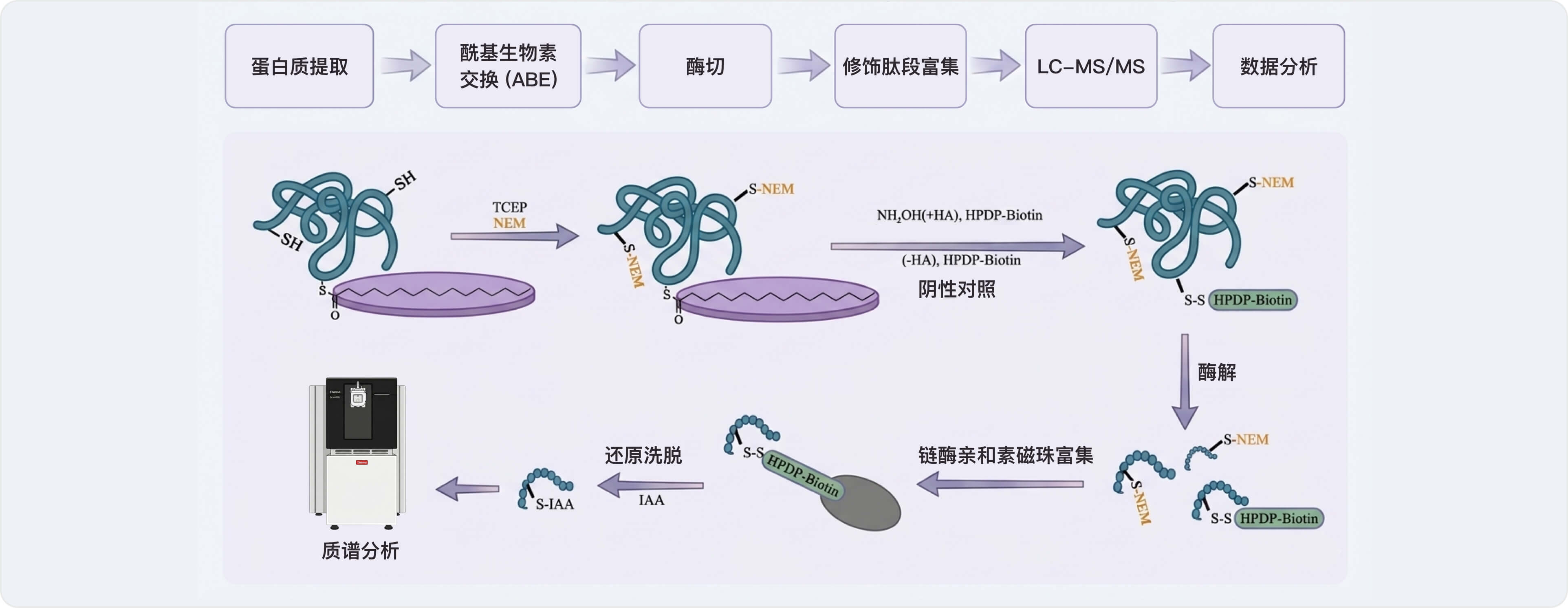
The basic procedure for Palmitomics experiments is as follows: The classic acyl-biotin exchange (ABE) method is used to reduce the palmitoylation modification of proteins to free thiol groups (-SH), which are then labeled with biotin. Following enzyme digestion, biotin-labeled peptides (propalmitoylated peptides) are specifically enriched using streptavidin magnetic beads. The peptides are then eluted and detected using mass spectrometry. Since the palmitoylation site has been converted to alkylation modification (immobilized modification) before mass spectrometry detection, a final library search can identify the propalmitoylation site.
Data Analysis
Standard data analysis content
1. Screening and analysis of differentially palmitoylated peptides
- Quantitative results of palmitoylation sites
- Identification results of palmitoylation sites
- Analysis of differential palmitoylation sites
- Cluster analysis of palmitoylation sites
- Motif analysis of palmitoylated peptides
2. Functional analysis of proteins containing differentially palmitoylated peptides
- GO Functional Annotation and Enrichment
- KEGG Pathway Annotation and Enrichment
- Subcellular Localization Analysis (CC)
- Protein-Functional Interaction Network (PFIN) Analysis
Sample Submission Requirements
- Sample Type
- Common Animal Tissues (brain, liver, spleen, lungs, kidneys, muscles, etc.)
- Sample Quantity
- 300mg
- Sample Type
- Plant Tissues (leaves, flowers, etc.)
- Sample Quantity
- 2g
- Sample Type
- cell
- Sample Quantity
- 6*10^7
- Sample Type
- Pure Protein
- Sample Quantity
- 6mg
| Sample Type | Sample Quantity |
|---|---|
| Common Animal Tissues (brain, liver, spleen, lungs, kidneys, muscles, etc.) | 300mg |
| Plant Tissues (leaves, flowers, etc.) | 2g |
| cell | 6*10^7 |
| Pure Protein | 6mg |
References
Zhou, Bo, et al Low-Background Acyl-Biotinyl Exchange Largely Eliminates the Coisolation of Non-S-Acylated Proteins and Enables Deep S-Acylproteomic Analysis Analytical Chemistry, 2019; 91.15.
Mesquita, Francisco S., et al Mechanisms and functions of protein S-acylation Nat Rev Mol Cell Biol, 2024;25(6):488-509.

Shenzhen Wininnovate Bio Co., Ltd.
Innovative mass spectrometry and AI technologies provide protein and metabolite mass spectrometry multi-omics solutions for life science research, empowering the growth of the biotechnology, pharmaceutical, and healthcare industries.


