

Product Overview
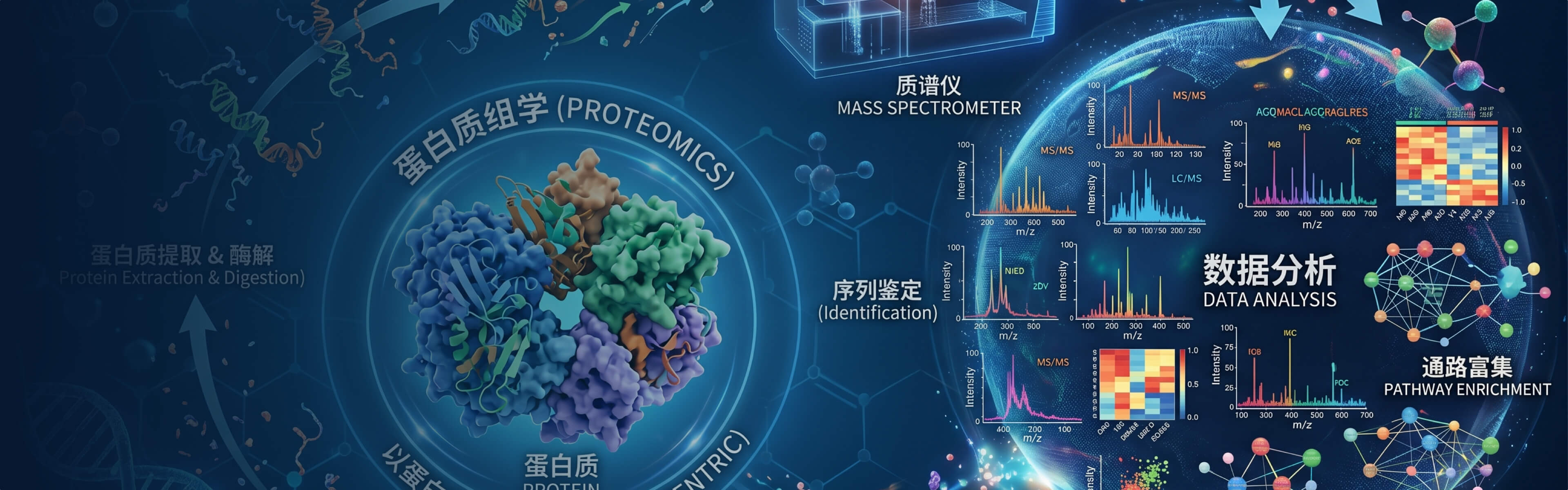
In the exploration of life sciences, while the genome and transcriptome draw up the "blueprint" of life, proteins, as the core executors of function, are the true "builders" that determine cell phenotype and fate. Traditional bulk studies, due to the "average" effect, obscure the valuable truth of heterogeneity between cells. Furthermore, mechanisms such as translational regulation and protein degradation often result in a correlation of less than 0.5 between mRNA and protein abundance. This means that relying solely on genome and transcriptome analysis, nearly half of the key regulatory information in life activities remains in the blind spot of observation. The emergence of single-cell proteomics technique, through highly sensitive identification, directly restores the "true value" of cellular physiological states, not only bridging the cognitive gap from transcription to phenotype but also making a breakthrough by capturing the phosphorylation and acetylation switches, which determine protein activity. This in-depth analysis from "blueprint" to "execution layer" empowers researchers to see through functional differences in tumor evolution, immune response, and development at the microscopic scale of a single cell, providing a pixel-level window closest to the essence of life for analyzing complex life phenomena, identifying clinical drug targets, and achieving precision medicine.
Technical Process
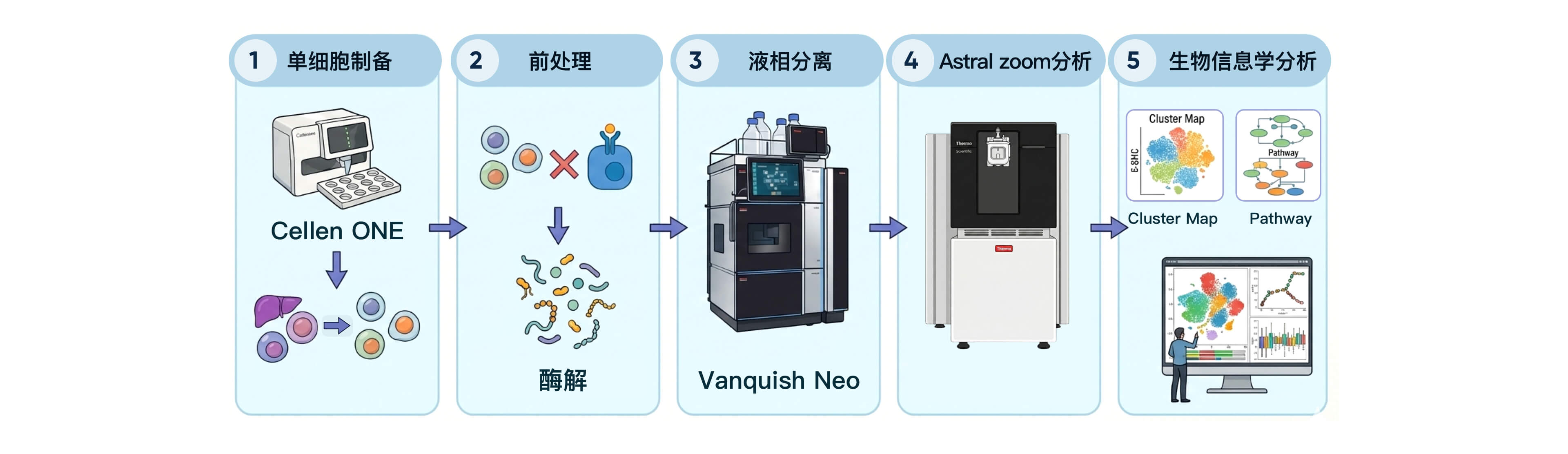
Single-cell preparation → Micro-sample pretreatment → Liquid chromatography separation → High-sensitivity mass spectrometry identification → Bioinformatics analysis
Technological Advantages
① We own the first Astral Zoom mass spectrometer in the South China commercial sector, which is also the world's most advanced mass spectrometer, offering greater flexibility, higher throughput, deeper coverage, higher sensitivity, and more precise quantification.
② Astral scans at speeds up to 200 Hz. Combined with Zoom mode and optimized ion processing, single-sample analysis time can be reduced to just a few minutes. It can support large-scale cohort studies of thousands or even tens of thousands of single cells (such as large-scale clinical sample typing), enabling proteomics to truly achieve statistical power on a scale equivalent to single-cell transcriptomics (scRNA-seq).
③ Astral possesses extremely high ion transport efficiency and ion accumulation capacity. Even with weak signals, it can accumulate enough ions for high-mass spectrometry analysis in a very short time. It can identify transcription factors, kinases, and signal transduction proteins that are inaccessible to traditional instruments. This is crucial for studying subtle biological processes such as cell fate determination.
Sample Submission Requirements
- Cell Types
- Cultured Cells (suspension/adherent)
- Sample Quantity
- ≥1×10^6
- Precautions
- Cell viability > 90%. Cells should be growing well and in the logarithmic growth phase. When sending, fill the culture flask with culture medium and send the sample at room temperature
- Cell Types
- Isolate Single Cells
- Sample Quantity
- Target analysis quantity × 120%
- Precautions
- Dry ice transportation
- Cell Types
- Cryopreserved Cells
- Sample Quantity
- ≥1×10^6
- Precautions
- Cell count ≥1×10^6 and cell viability >90% before cryopreservation. Cryopreservation solution: 90% FBS + 10% DMSO. Use programmed freezing or gradient cryopreservation boxes, store in liquid nitrogen or at -80℃ for up to one week before delivery
- Cell Types
- Germ Cells (oocytes/zygotes)
- Sample Quantity
- ≥1
- Precautions
- Cells are placed in EP tubes and transported on dry ice
- Cell Types
- Blood
- Sample Quantity
- ≥2mL
- Precautions
- Freshly collected in EDTA anticoagulant tubes and transported at 4°C
- Cell Types
- Tissue
- Sample Quantity
- ≥200mg
- Precautions
- Immediately after collection, the tissue was preserved in a tissue preservation solution and transported at 4°C
| Cell Types | Sample Quantity | Precautions |
|---|---|---|
| Cultured Cells (suspension/adherent) | ≥1×10^6 | Cell viability > 90%. Cells should be growing well and in the logarithmic growth phase. When sending, fill the culture flask with culture medium and send the sample at room temperature |
| Isolate Single Cells | Target analysis quantity × 120% | Dry ice transportation |
| Cryopreserved Cells | ≥1×10^6 | Cell count ≥1×10^6 and cell viability >90% before cryopreservation. Cryopreservation solution: 90% FBS + 10% DMSO. Use programmed freezing or gradient cryopreservation boxes, store in liquid nitrogen or at -80℃ for up to one week before delivery |
| Germ Cells (oocytes/zygotes) | ≥1 | Cells are placed in EP tubes and transported on dry ice |
| Blood | ≥2mL | Freshly collected in EDTA anticoagulant tubes and transported at 4°C |
| Tissue | ≥200mg | Immediately after collection, the tissue was preserved in a tissue preservation solution and transported at 4°C |
Note: Freshly collected samples should be sent to the laboratory as soon as possible to prevent the condition of the samples from being affected during storage or transportation.
Reference
SCoPE-MS: Mass Spectrometry of Single Mammalian Cells to Quantify Proteomic Heterogeneity During Cell Differentiation
Achieving higher throughput proteomic fractionation through parallel pre-accumulation and optimized ion processing in the Orbitrap Astral Zoom mass spectrometer
Utilizing prior information-guided DIA technique to achieve targeted quantification of key regulatory proteins determining cell fate at the single-cell level.

Shenzhen Wininnovate Bio Co., Ltd.
Innovative mass spectrometry and AI technologies provide protein and metabolite mass spectrometry multi-omics solutions for life science research, empowering the growth of the biotechnology, pharmaceutical, and healthcare industries.


