


Product Overview
Parallel Reaction Monitoring (PRM) is an ion monitoring technique based on high-resolution and high-precision mass spectrometry, used for the absolute quantification of proteins or peptides. PRM is well-suited for quantifying multiple low-abundance proteins in complex samples. PRM is based on a quadrupole high-resolution mass spectrometry platform, typically represented by the Q-Orbitrap. Unlike SRM, which scans only one parent-daughter ion pair at a time, PRM scans all parent-daughter ion pairs of the parent ion, i.e., it monitors all fragment ions of the parent ion in parallel. First, PRM uses a quadrupole (Q1) to select the parent ion, typically with a selection window of m/z ≤ 2; then, the parent ion fragments in the collision cell (Q2); finally, the Orbitrap, replacing Q3, scans all fragment ions with high resolution and high precision. Therefore, PRM technique not only possesses the targeted quantitative analysis capabilities of SRM/MRM but also qualitative functions.
(1) The quality accuracy can reach the ppm level, and its ability to distinguish between background interference and false positives is better than SRM/MRM, effectively improving the detection limit and sensitivity in complex backgrounds;
(2) Full scan of daughter ions, no need to select ion pairs and optimize fragmentation energy, making it easy to establish analytical methods;
(3) Wide linear range, which can increase by 5-6 orders of magnitude.
Technical Route
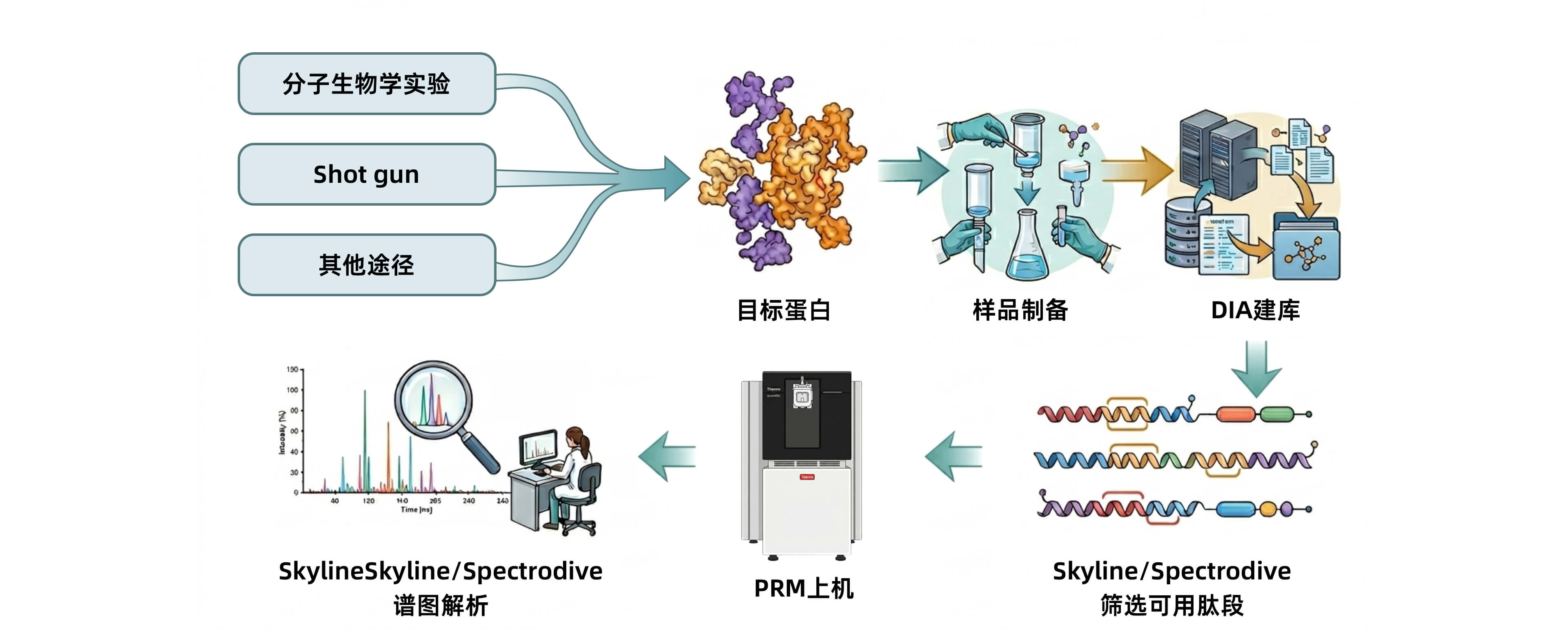
.jpg)
PRM Applications
After obtaining numerous differentially expressed proteins through various high-throughput relative quantitative analyses such as TMT, label-free, and DIA, these differentially expressed proteins require further identification to obtain more accurate information on the relative abundance of protein expression. This is typically confirmed using methods such as Western blotting and ELISA. However, mass spectrometry (MS) offers targeted quantitative analysis of target proteins with accuracy and sensitivity comparable to Western blotting, but with higher throughput, identifying 1-100 proteins at a time, and at a lower cost.
- Identification of differentially expressed proteins screened by proteomics (TMT, DIA, etc.)
- Absolute quantification of proteins or peptides
- Quantification of disease markers for establishing diagnostic models
- Quantification of phosphorylated/methylated proteins
- Quantitative analysis of signaling pathways
References
Kienle S M, Sigg M, Schneider T,et al Non-hydrolyzable acetyllysine analogs to study protein acetylation in vitro and in cells[J] Nature Communications, 2026;17(1).DOI: 10.1038/s41467-026-69782-6
Wang, X., Ma, X., Zhang, X. et al Study on biomarkers of homocysteine-induced transformation of vascular smooth muscle cells into foam cells Sci Rep 16, 2026;7411.
Nishimura Y, Langan-Evans C, Taylor HL, Foo WL, Morton JP, Shepherd S, Strauss JA, Burniston JG, Areta JL Endocrine, Metabolic, and Skeletal Muscle Proteomic Responses During Energy Deficit With Concomitant Aerobic Exercise in Humans FASEB J, 2025 Nov 15;39(21):e71163.DOI: 10.1096/fj.202502384RR

Shenzhen Wininnovate Bio Co., Ltd.
Innovative mass spectrometry and AI technologies provide protein and metabolite mass spectrometry multi-omics solutions for life science research, empowering the growth of the biotechnology, pharmaceutical, and healthcare industries.


