

Product Overview
Traditional Chinese medicine (TCM) compound formulas are characterized by "complex components and numerous targets." Their pharmacodynamic basis is usually not the original medicinal materials, but rather the active ingredients and their metabolites absorbed into the bloodstream and reaching the target tissues. The technology for identifying TCM components entering the blood/tissues utilizes a highly sensitive liquid chromatography-mass spectrometry (LC-MS) analysis method to detect migrating components in serum, plasma, or tissue samples after drug administration. Combined with a dedicated database, this allows for rapid and accurate identification, elucidating the directly acting substances of TCM in vivo.
Technological Advantages
1. Robust Self-built Traditional Chinese Medicine Database (Wininnovate-TCM 1.0): Includes over 500 commonly used clinical TCM herbs, covering more than 13,000 compounds. This database is specifically designed for blood/tissue components, containing precise molecular weight and multi-level mass spectrometry fragment information, significantly improving the success rate of identifying trace migrating components.
2. High Sensitivity and Dedicated Analytical Strategies: Employs a high-resolution mass spectrometer (QE series), combined with extended chromatographic gradients (e.g., 30-60 minutes) and blank matrix matching filtration technology to effectively eliminate biological matrix interference, achieving reliable capture of trace (pg-level) blood-borne components.
3. Multidimensional Confirmation and Manual Verification: Integrates "retention time + precise mass number from primary mass spectrometry + fragment matching from secondary mass spectrometry" for multidimensional qualitative analysis. A senior TCM analysis team manually verifies each positive identification result using secondary spectrograms to eliminate false positives and ensure data authenticity and reliability.
Technical Process
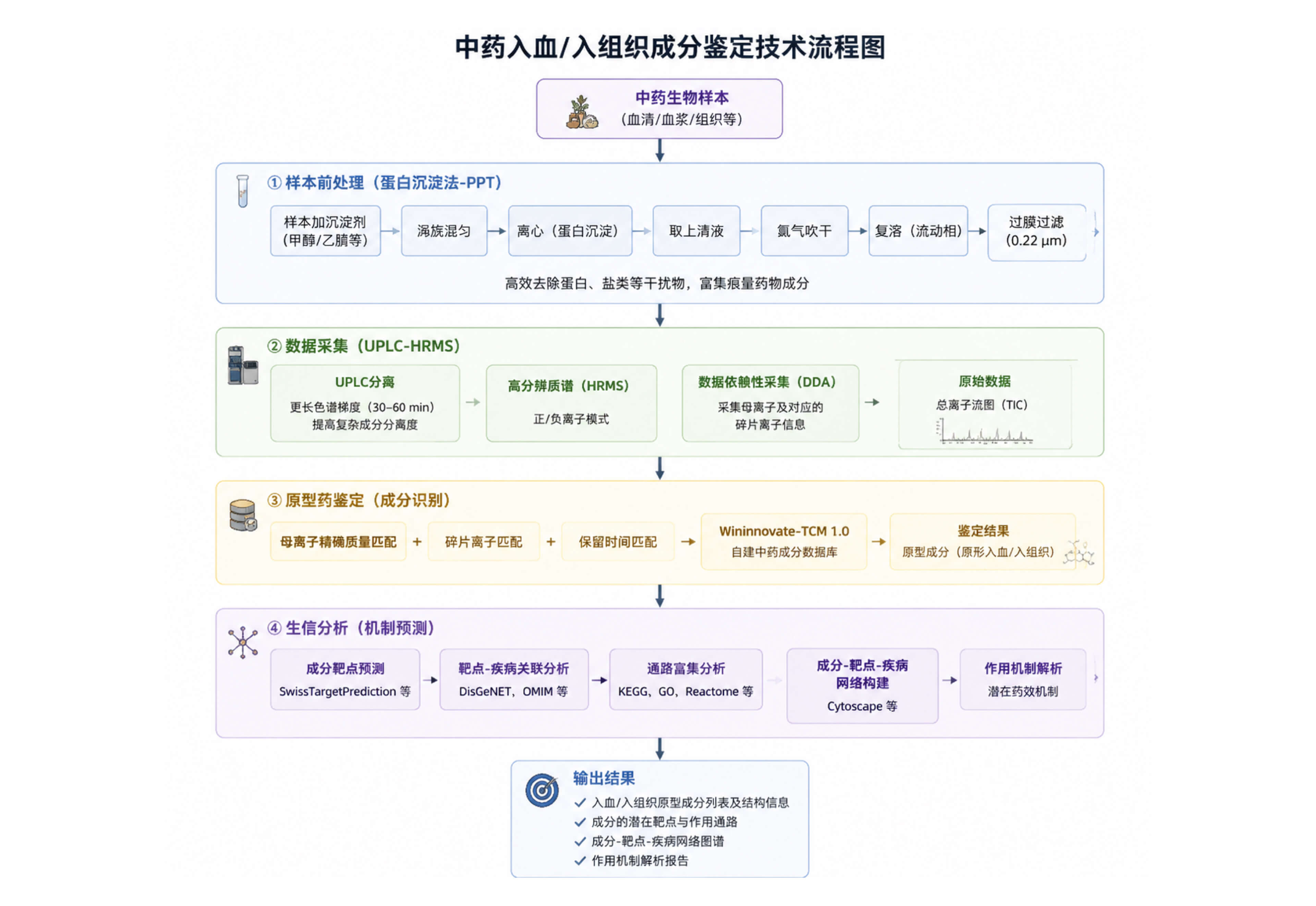
Key Processing Nodes
1. Sample Pretreatment: For complex biological matrices such as serum, plasma, and tissue, protein precipitation (PPT) is used to efficiently remove interfering substances such as proteins and salts, enriching trace drug components.
2. Data Acquisition: An ultra-high performance liquid chromatography-high resolution mass spectrometry (UPLC-HRMS) platform is used in data-dependent acquisition (DDA) mode, acquiring data in both positive and negative ion modes. Longer chromatographic gradients (e.g., 30-60 minutes) are employed to improve the separation of complex components.
3. Prototype Drug Identification: The obtained precursor ion and fragment ion information is matched with the Wininnovate-TCM 1.0 self-built database. Prototype components (entering the bloodstream in their original form) can be identified.
4. Bioinformatics Analysis: Combining network pharmacology, target prediction, pathway enrichment, and component-target-disease network construction are performed to predict the potential mechanisms by which the drug exerts its effects in the bloodstream.
Case Studies
.jpg) Yang, Y. U., Yang, X. I. N., Hai-jun, W. A. N. G., Qing-zhu, Y. A. N. G., & Wei-ming, W. A. N. G. (2024). Screening of the Active Components of Qinbai Qingfei Concentrated Pill on Treating Pneumonia Based on UHPLC/Q-Exactive Orbitrap MS Uniting Network Pharmacology. Journal of Chinese Mass Spectrometry Society, 45(6), 884-896.
Yang, Y. U., Yang, X. I. N., Hai-jun, W. A. N. G., Qing-zhu, Y. A. N. G., & Wei-ming, W. A. N. G. (2024). Screening of the Active Components of Qinbai Qingfei Concentrated Pill on Treating Pneumonia Based on UHPLC/Q-Exactive Orbitrap MS Uniting Network Pharmacology. Journal of Chinese Mass Spectrometry Society, 45(6), 884-896.
Sample Submission Requirements
- Sample Type
- Chinese medicinal herbs/processed slices
- Minimum Sample Quantity
- ≥5 g
- Storage & Transportation Conditions
- Store at room temperature, in a dry place, away from light; transport by express courier.
- Precautions
- It is recommended to pulverize the material and send it for testing. Please provide information on the identification of the medicinal material.
- Sample Type
- Chinese medicine powder/granules/capsules
- Minimum Sample Quantity
- ≥5 g
- Storage & Transportation Conditions
- Store at room temperature in a dry place; transport by express delivery.
- Precautions
- Simply send the contents powder for testing.
- Sample Type
- Compound decoction/oral liquid
- Minimum Sample Quantity
- ≥20 mL
- Storage & Transportation Conditions
- Store frozen at -20℃; transport with dry ice.
- Precautions
- It is recommended to repackage the product, with each tube not exceeding 2/3 of its volume, to avoid freezing and cracking.
- Sample Type
- Drug-containing serum/plasma
- Minimum Sample Quantity
- ≥500 μL
- Storage & Transportation Conditions
- Store at -80℃; transport with dry ice.
- Precautions
- To avoid repeated freeze-thaw cycles, it is recommended to repackage and freeze the product.
- Sample Type
- Animal Tissue
- Minimum Sample Quantity
- ≥20 mg
- Storage & Transportation Conditions
- Flash-freeze with liquid nitrogen and store at -80°C; transport with dry ice.
- Precautions
- After sampling, the sample should be immediately placed in liquid nitrogen to prevent degradation.
- Sample Type
- Medicated urine
- Minimum Sample Quantity
- ≥500 μL
- Storage & Transportation Conditions
- Store at -80℃; transport with dry ice.
- Precautions
- It is recommended to use metabolic cages to collect mixed urine samples.
| Sample Type | Minimum Sample Quantity | Storage & Transportation Conditions | Precautions |
|---|---|---|---|
| Chinese medicinal herbs/processed slices | ≥5 g | Store at room temperature, in a dry place, away from light; transport by express courier. | It is recommended to pulverize the material and send it for testing. Please provide information on the identification of the medicinal material. |
| Chinese medicine powder/granules/capsules | ≥5 g | Store at room temperature in a dry place; transport by express delivery. | Simply send the contents powder for testing. |
| Compound decoction/oral liquid | ≥20 mL | Store frozen at -20℃; transport with dry ice. | It is recommended to repackage the product, with each tube not exceeding 2/3 of its volume, to avoid freezing and cracking. |
| Drug-containing serum/plasma | ≥500 μL | Store at -80℃; transport with dry ice. | To avoid repeated freeze-thaw cycles, it is recommended to repackage and freeze the product. |
| Animal Tissue | ≥20 mg | Flash-freeze with liquid nitrogen and store at -80°C; transport with dry ice. | After sampling, the sample should be immediately placed in liquid nitrogen to prevent degradation. |
| Medicated urine | ≥500 μL | Store at -80℃; transport with dry ice. | It is recommended to use metabolic cages to collect mixed urine samples. |
General Requirements: 1. Biological replication: 6-10 samples per group are recommended for routine experiments; ≥25 samples per group are recommended for clinical cohort studies. 2. Sample identification: Please clearly label the sample number using waterproof labels and include a sample information sheet. 3. Transportation: Please use sufficient dry ice (5-10 kg/day) to ensure the samples arrive still wrapped in dry ice.
References
Yang, Y. U., Yang, X. I. N., Hai-jun, W. A. N. G., Qing-zhu, Y. A. N. G., & Wei-ming, W. A. N. G Screening of the Active Components of Qinbai Qingfei Concentrated Pill on Treating Pneumonia Based on UHPLC/Q-Exactive Orbitrap MS Uniting Network Pharmacology Journal of Chinese Mass Spectrometry Society, 2024;45(6), 884-896.

Shenzhen Wininnovate Bio Co., Ltd.
Innovative mass spectrometry and AI technologies provide protein and metabolite mass spectrometry multi-omics solutions for life science research, empowering the growth of the biotechnology, pharmaceutical, and healthcare industries.


