


Product Overview
Lipidomics, an important branch of metabolomics, aims to provide a comprehensive and systematic analysis of lipid molecules in biological samples. Lipids are not only structural components of cell membranes and energy storage molecules, but also participate in key life activities such as signal transduction, inflammatory responses, and apoptosis. Untargeted lipidomics employs unbiased detection strategies and utilizes high-resolution liquid chromatography-mass spectrometry (LC-MS) platforms to identify and quantify all lipid molecules in biological samples on a large scale, thereby revealing the relationship between lipid metabolism and physiological and pathological processes.
Technical Advantages
1. Internationally Standard Lipid Search Engine: Lipid identification is performed using Thermo Scientific LipidSearch 5.1 software, jointly developed by Professor Ryo Taguchi of Japan and Mitsui Knowledge Industry Co., Ltd., and is widely recognized as the gold standard software in the field of lipidomics.
2. Massive Professional Database: LipidSearch 5.1's built-in database contains over 1.5 million lipid ions and their predicted fragment ions, covering 96 lipid subclasses. It supports various sample types, including cells, plasma, tissues, plants, and yeast, offering industry-leading identification coverage.
3. Dual Algorithm Identification Modes: The software provides both Group-specific (targeted) and Comprehensive (untargeted) identification algorithms, optimized for screening known lipids and discovering unknown lipids, respectively, to meet diverse research needs.
4. Intelligent Peak Detection and Alignment: Unique peak detection algorithms are customized for different types of mass spectrometers and MS experiments. Retention time windows are automatically aligned before quantitative analysis to ensure more accurate relative quantification.
5. Rigorous multi-level quality control system: Combining multiple quality control measures such as QC samples, internal standards, and blank samples, low-quality identification results are automatically filtered through built-in quality control indicators such as Rej (quality rejection parameter) and PQ (peak quality parameter) of LipidSearch to ensure data reliability.
Technical Process
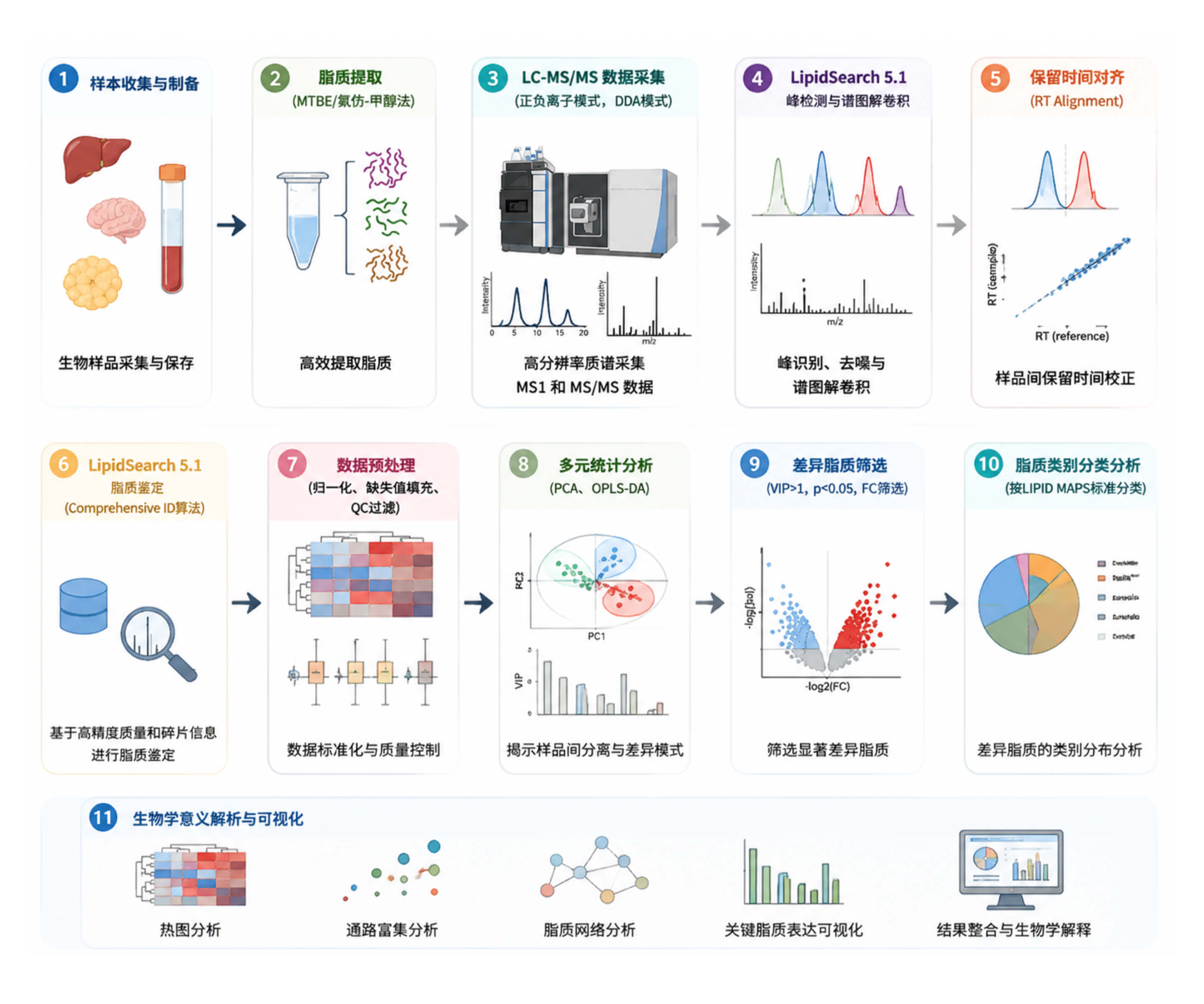
Key processing nodes explained:
1. Lipid Extraction: Liquid-liquid extraction using methyl tert-butyl ether (MTBE) or chloroform-methanol (Folch) methods achieves efficient separation of lipids from proteins and polar metabolites. This method is simple to operate, has high recovery rates, and broad lipid coverage.
2. Data Acquisition: Data-dependent acquisition (DDA) mode is employed, acquiring data in both positive and negative ion modes to maximize lipid molecular coverage. LipidSearch 5.1 is optimized for Thermo Scientific Orbitrap series mass spectrometers and is compatible with mainstream high-resolution mass spectrometry platforms such as Q Exactive, Orbitrap Fusion, and Orbitrap Astral.
3. Library Search and Identification: Automated lipid identification is performed using LipidSearch 5.1 software. First, a search for specified monoisotope precursor ions (mass tolerance ±5 ppm) is conducted in the MS data within a user-editable database. Then, a product ion search is performed. Finally, the MS and MS/MS search results are combined to obtain total composition (precursor) and molecular (product ion) results, respectively. The software employs a scoring algorithm to filter out low-probability results, ensuring the reliability of the identification.
4. Quality Control Filtering: Strict quality control standards are applied to the identification results: Rej = 0, PQ > 0.85, RSD < 30% in QC samples, ensuring data quality.
5. Bioinformatics Analysis: Standard analytical methods are provided, including Principal Component Analysis (PCA), Orthogonal Partial Least Squares Discriminant Analysis (OPLS-DA), volcano plots, heatmaps, lipid category proportion analysis, and correlation network analysis. LipidSearch supports exporting results to Excel/TXT formats and can seamlessly integrate with advanced statistical software such as SIMCA and MetaboAnalyst.
Case Studies
:Fu Y, Chen N, Wang Z, et al. Degradation of lipid droplets by chimeric autophagy-tethering compounds. Cell Research, 2021, 31(9): 965-979.

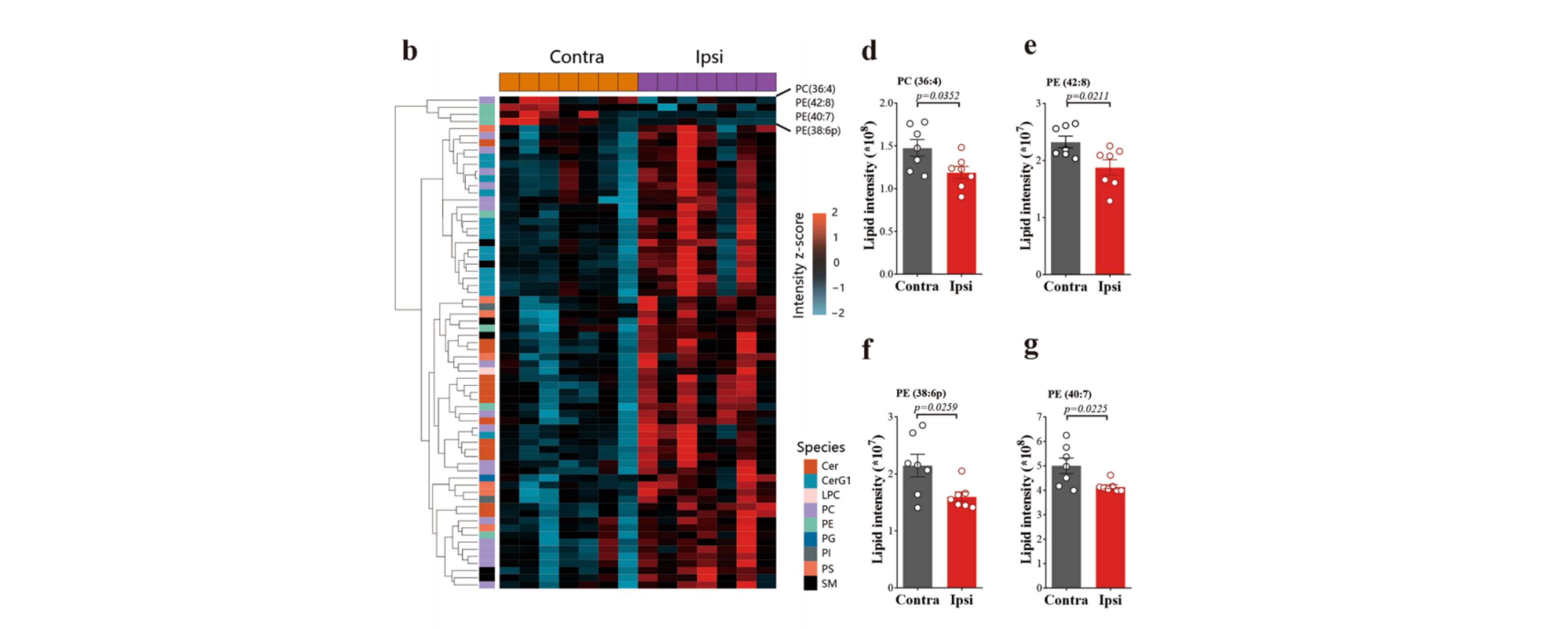
:Tuo QZ, Liu Y, Xiang Z, et al. Thrombin induces ACSL4-dependent ferroptosis during cerebral ischemia/reperfusion. Signal Transduction and Targeted Therapy, 2022, 7(1): 59.
Sample Submission Requirements
- Sample Type
- Serum / Plasma
- Standard Sample Quantity
- ≥200 μL
- Minimum Sample Quantity
- ≥100 μL
- Storage & Transportation Conditions
- Store at -80℃ and transport with dry ice.
- Precautions
- To avoid hemolysis, it is recommended to aliquot and freeze the plasma, avoiding repeated freeze-thaw cycles; 100 μL of human plasma is sufficient for LipidSearch identification.
- Sample Type
- Animal Tissue
- Standard Sample Quantity
- ≥50 mg
- Minimum Sample Quantity
- ≥30 mg
- Storage & Transportation Conditions
- Flash-freeze with liquid nitrogen, store at -80°C, transport with dry ice.
- Precautions
- Place the sample in liquid nitrogen as soon as possible after sampling (<30 minutes).
- Sample Type
- Cell
- Standard Sample Quantity
- 1×10^7Cell
- Minimum Sample Quantity
- 0.5×10^7Cell
- Storage & Transportation Conditions
- Collect the precipitate after quenching metabolism, store at -80℃, and transport with dry ice.
- Precautions
- At least 6 biological replicates are recommended; identification can be completed with 1×10^6 yeast cells.
- Sample Type
- Urine
- Standard Sample Quantity
- ≥200 μL
- Minimum Sample Quantity
- ≥100 μL
- Storage & Transportation Conditions
- Store at -80℃ and transport with dry ice.
- Precautions
- First morning urine is recommended.
- Sample Type
- Plant Tissue
- Standard Sample Quantity
- ≥200 mg
- Minimum Sample Quantity
- ≥100 mg
- Storage & Transportation Conditions
- Flash-freeze with liquid nitrogen, store at -80°C, transport with dry ice.
- Precautions
- It is recommended to set up independent biological replicates (≥6); seed oil samples are suitable for the LipidSearch database.
- Sample Type
- Cell Supernatant / Fermentation Broth
- Standard Sample Quantity
- ≥200 μL
- Minimum Sample Quantity
- ≥100 μL
- Storage & Transportation Conditions
- Store at -80℃ and transport with dry ice.
- Precautions
- Collect after centrifugation to remove cell debris
- Sample Type
- Cerebrospinal Fluid / Follicular Fluid / Bile
- Standard Sample Quantity
- ≥200 μL
- Minimum Sample Quantity
- ≥100 μL
- Storage & Transportation Conditions
- Store at -80℃ and transport with dry ice.
- Precautions
- It is recommended to store in portions.
- Sample Type
- Extremely Small Sample
- Standard Sample Quantity
- —
- Minimum Sample Quantity
- 1 oocyte / 1mg tissue
- Storage & Transportation Conditions
- Special collection tubes, dry ice transportation
- Precautions
- Need to communicate with technical support in advance to confirm the solution.
| Sample Type | Standard Sample Quantity | Minimum Sample Quantity | Storage & Transportation Conditions | Precautions |
|---|---|---|---|---|
| Serum / Plasma | ≥200 μL | ≥100 μL | Store at -80℃ and transport with dry ice. | To avoid hemolysis, it is recommended to aliquot and freeze the plasma, avoiding repeated freeze-thaw cycles; 100 μL of human plasma is sufficient for LipidSearch identification. |
| Animal Tissue | ≥50 mg | ≥30 mg | Flash-freeze with liquid nitrogen, store at -80°C, transport with dry ice. | Place the sample in liquid nitrogen as soon as possible after sampling (<30 minutes). |
| Cell | 1×10^7Cell | 0.5×10^7Cell | Collect the precipitate after quenching metabolism, store at -80℃, and transport with dry ice. | At least 6 biological replicates are recommended; identification can be completed with 1×10^6 yeast cells. |
| Urine | ≥200 μL | ≥100 μL | Store at -80℃ and transport with dry ice. | First morning urine is recommended. |
| Plant Tissue | ≥200 mg | ≥100 mg | Flash-freeze with liquid nitrogen, store at -80°C, transport with dry ice. | It is recommended to set up independent biological replicates (≥6); seed oil samples are suitable for the LipidSearch database. |
| Cell Supernatant / Fermentation Broth | ≥200 μL | ≥100 μL | Store at -80℃ and transport with dry ice. | Collect after centrifugation to remove cell debris |
| Cerebrospinal Fluid / Follicular Fluid / Bile | ≥200 μL | ≥100 μL | Store at -80℃ and transport with dry ice. | It is recommended to store in portions. |
| Extremely Small Sample | — | 1 oocyte / 1mg tissue | Special collection tubes, dry ice transportation | Need to communicate with technical support in advance to confirm the solution. |
General Requirements: 1. Biological replicates: 6-10 replicates per group are recommended for routine experiments; ≥25 replicates per group are recommended for clinical cohort studies. 2. Internal standard addition: It is recommended to add a lipid internal standard mixture such as SPLASH™ before extraction for calibration and relative quantification. 3. Sample identification: Please clearly label the sample number using waterproof labels and include a sample information sheet. 4. Transportation: Please use sufficient dry ice (5-10 kg/day) to ensure the samples arrive still wrapped in dry ice.
References
Fu Y, Chen N, Wang Z, et al Degradation of lipid droplets by chimeric autophagy-tethering compounds. Cell Research, 2021;31(9): 965-979.
Tuo QZ, Liu Y, Xiang Z, et al Thrombin induces ACSL4-dependent ferroptosis during cerebral ischemia/reperfusion Signal Transduction and Targeted Therapy, 2022;7(1): 59.

Shenzhen Wininnovate Bio Co., Ltd.
Innovative mass spectrometry and AI technologies provide protein and metabolite mass spectrometry multi-omics solutions for life science research, empowering the growth of the biotechnology, pharmaceutical, and healthcare industries.


