


Product Overview
GC-MS untargeted metabolomics is a technique that uses gas chromatography-mass spectrometry to comprehensively and unbiasedly detect and compare all volatile or derivatizable small molecule metabolites (typically with a molecular weight <500 Da) in biological samples. It is particularly suitable for analyzing core metabolites such as organic acids, amino acids, sugars, alcohols, and short-chain fatty acids, and is one of the most stable and mature technology platforms in metabolomics research.
Technological Advantages
1. The Agilent 8890-5977B gas chromatography-single quadrupole mass spectrometry system is used. This system boasts excellent separation capabilities, high sensitivity (ppm level), and a wide dynamic range, making it ideal for qualitative and relative quantitative analysis of targeted and non-targeted metabolites.
2. Professional qualitative analysis software: MS-DIAL is used as the core data processing software. This software integrates powerful deconvolution functions, retention index correction, and public spectral library matching capabilities, effectively improving the accuracy and efficiency of metabolite identification, and is particularly suitable for GC-MS data analysis of complex biological samples.
3. A rigorous quality control system: By using QC samples, blank samples, and internal standards (such as ribitol, C13-stearic acid, etc.), the entire process from sample pretreatment to data acquisition is monitored to ensure data stability and batch-to-batch reproducibility.
Technical Process
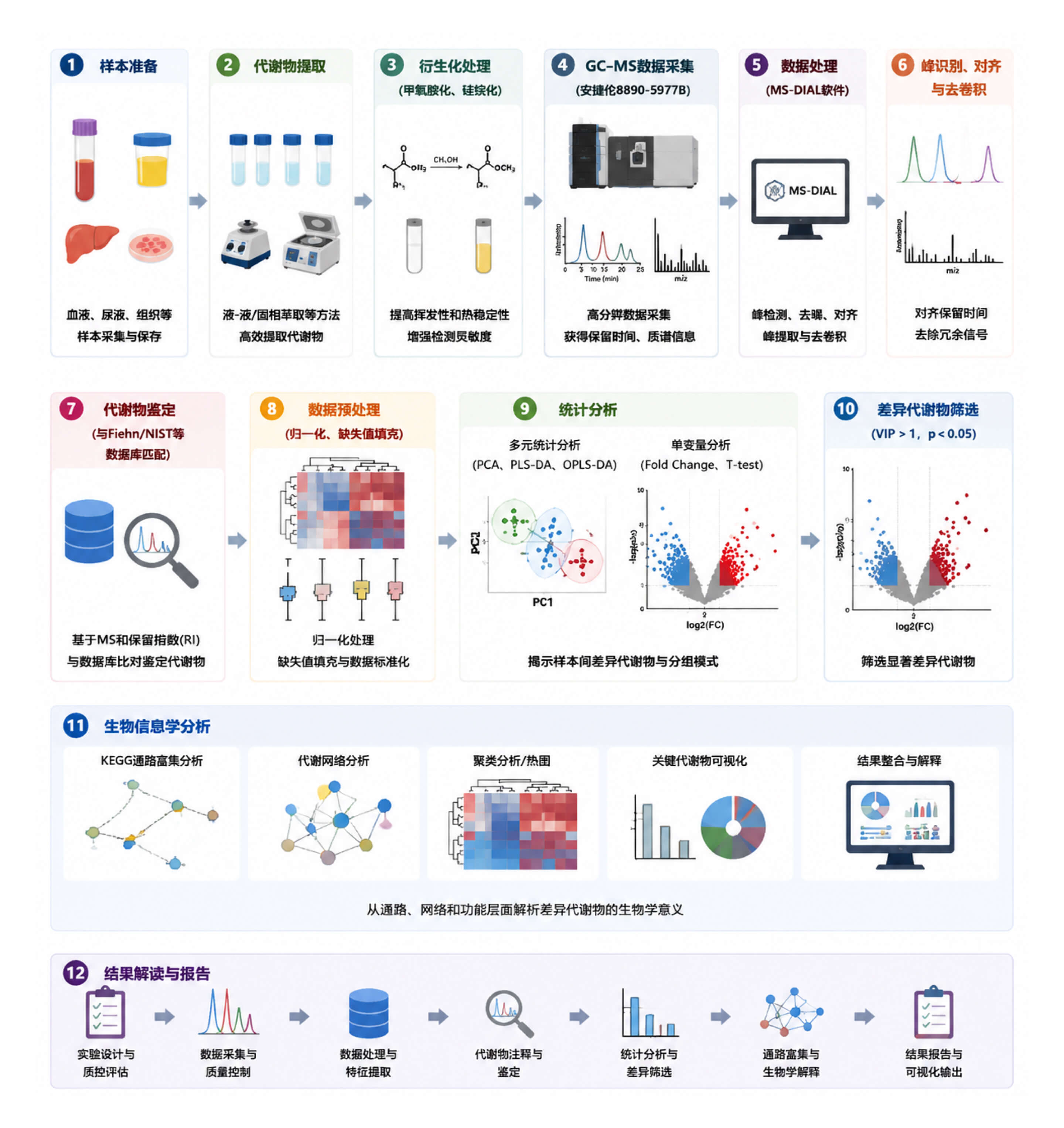
Key processing nodes explained
1. Sample Pretreatment and Derivatization: Optimized metabolite extraction protocols are employed based on sample type (tissue, serum, cells, etc.). Since most endogenous metabolites are highly polar and low in volatility, a two-step derivatization process (e.g., methoxyamination, silanization) is required to convert them into volatile derivatives.
2. Data Acquisition: Processed samples undergo efficient physical separation using gas chromatography (GC), followed by full-scan detection using single quadrupole mass spectrometry (SQMS). This platform is ideal for stable and reliable non-targeted metabolomics analysis.
3. Data Processing and Metabolite Identification: MS-DIAL software is used for preprocessing raw data, including peak identification, peak alignment, noise filtering, and deconvolution. Metabolite structure identification is achieved by matching the retention index (RI) and mass spectra of metabolites with public databases such as Fiehn and NIST, as well as a self-built library.
4. Bioinformatics Analysis: In-depth analysis of all identified metabolites, providing more than 10 standard analysis functions including principal component analysis (PCA), partial least squares discriminant analysis (PLS-DA), orthogonal partial least squares discriminant analysis (OPLS-DA), volcano plot, heatmap, cluster analysis, KEGG pathway enrichment analysis, and supporting personalized advanced analysis.
Case Studies
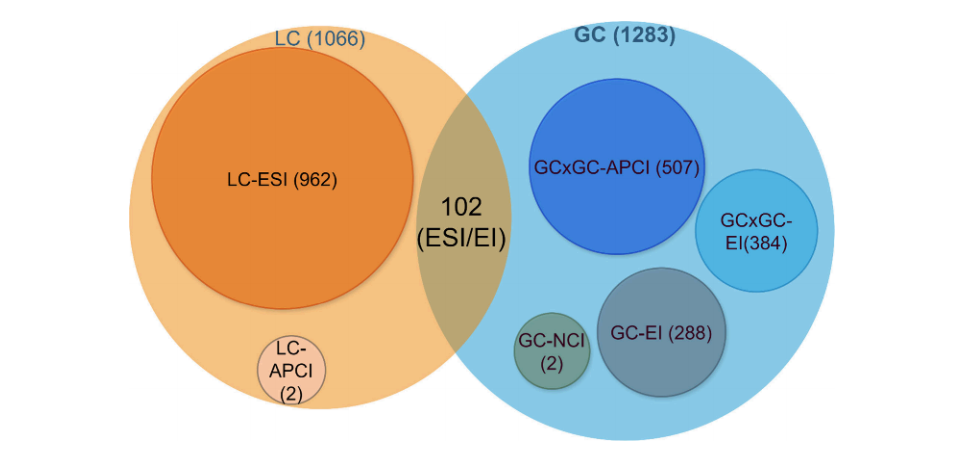
Case Studies:Newton, S. R., Bowden, J. A., Charest, N., Jackson, S. R., Koelmel, J. P., Liberatore, H. K., Lin, A. M., Lowe, C. N., Nieto, S., Pollitt, K. J. G., Robuck, A. R., Rostkowski, P., Townsend, T. G., Wallace, M. A. G., & Williams, A. J. (2025). Filling the Gaps in PFAS Detection: Integrating GC-MS Non-Targeted Analysis for Comprehensive Environmental Monitoring and Exposure Assessment. Environmental Science & Technology Letters, 12(2), 104-112.
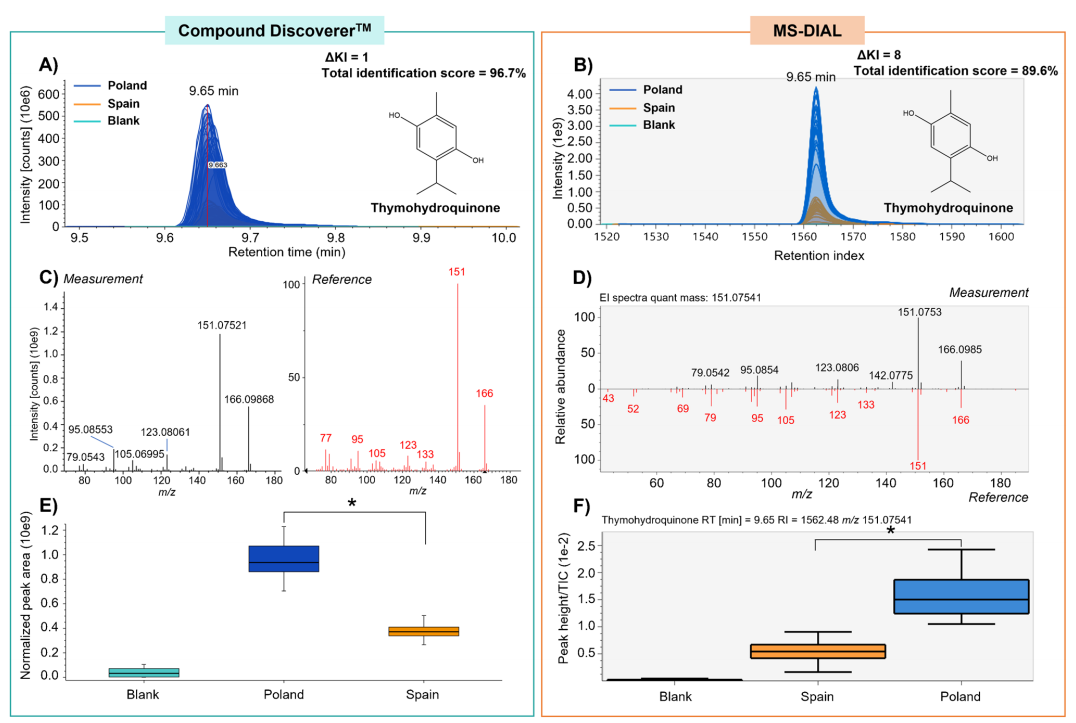
Case Studies:Rivera-Pérez, A., & Garrido Frenich, A. (2024). Comparison of data processing strategies using commercial vs. open-source software in GC-Orbitrap-HRMS untargeted metabolomics analysis for food authentication: thyme geographical differentiation and marker identification as a case study. Analytical and Bioanalytical Chemistry, 416(17), 4045-4061.
Sample Submission Requirements
- Sample Type
- Serum/Plasma
- Minimum Sample Quantity
- ≥200 μL
- Storage & Transportation Conditions
- Store at -80℃ and transport with dry ice.
- Precautions
- To avoid hemolysis and hyperlipidemia, it is recommended to aliquot and freeze, and avoid repeated freeze-thaw cycles (no more than 3 times).
- Sample Type
- Animal Tissue
- Minimum Sample Quantity
- ≥50 mg
- Storage & Transportation Conditions
- Flash-freeze with liquid nitrogen, store at -80°C, transport with dry ice.
- Precautions
- After sampling, the sample should be placed in liquid nitrogen as soon as possible (<30 minutes) to quench its metabolism.
- Sample Type
- Plant Tissue
- Minimum Sample Quantity
- ≥80 mg
- Storage & Transportation Conditions
- Flash-freeze with liquid nitrogen, store at -80°C, transport with dry ice.
- Precautions
- It is recommended to have at least 6 biological replicates.
- Sample Type
- Urine
- Minimum Sample Quantity
- ≥500 μL
- Storage & Transportation Conditions
- Store at -80℃ and transport with dry ice.
- Precautions
- It is recommended to use first morning urine or 24-hour mixed urine, and preservatives (such as sodium azide) can be added.
- Sample Type
- Cells / Microbes
- Minimum Sample Quantity
- ≥1×10⁷ cell
- Storage & Transportation Conditions
- Collect the precipitate after quenching metabolism, store at -80℃, and transport with dry ice.
- Precautions
- It is recommended to have at least 6 biological replicates.
- Sample Type
- Feces / Intestinal Contents
- Minimum Sample Quantity
- ≥80 mg
- Storage & Transportation Conditions
- Flash-freeze with liquid nitrogen, store at -80°C, transport with dry ice.
- Precautions
- Rapid sampling is required to avoid degradation at room temperature.
- Sample Type
- Cell Supernatant / Culture Medium
- Minimum Sample Quantity
- ≥3 mL
- Storage & Transportation Conditions
- Store at -80℃ and transport with dry ice.
- Precautions
- Cell debris needs to be removed to avoid serum interference.
- Sample Type
- Extremely Small Sample
- Minimum Sample Quantity
- 1 cell / 1 mgtissue
- Storage & Transportation Conditions
- Special collection tubes, dry ice transportation
- Precautions
- Need to communicate with technical support in advance to confirm the solution.
| Sample Type | Minimum Sample Quantity | Storage & Transportation Conditions | Precautions |
|---|---|---|---|
| Serum/Plasma | ≥200 μL | Store at -80℃ and transport with dry ice. | To avoid hemolysis and hyperlipidemia, it is recommended to aliquot and freeze, and avoid repeated freeze-thaw cycles (no more than 3 times). |
| Animal Tissue | ≥50 mg | Flash-freeze with liquid nitrogen, store at -80°C, transport with dry ice. | After sampling, the sample should be placed in liquid nitrogen as soon as possible (<30 minutes) to quench its metabolism. |
| Plant Tissue | ≥80 mg | Flash-freeze with liquid nitrogen, store at -80°C, transport with dry ice. | It is recommended to have at least 6 biological replicates. |
| Urine | ≥500 μL | Store at -80℃ and transport with dry ice. | It is recommended to use first morning urine or 24-hour mixed urine, and preservatives (such as sodium azide) can be added. |
| Cells / Microbes | ≥1×10⁷ cell | Collect the precipitate after quenching metabolism, store at -80℃, and transport with dry ice. | It is recommended to have at least 6 biological replicates. |
| Feces / Intestinal Contents | ≥80 mg | Flash-freeze with liquid nitrogen, store at -80°C, transport with dry ice. | Rapid sampling is required to avoid degradation at room temperature. |
| Cell Supernatant / Culture Medium | ≥3 mL | Store at -80℃ and transport with dry ice. | Cell debris needs to be removed to avoid serum interference. |
| Extremely Small Sample | 1 cell / 1 mgtissue | Special collection tubes, dry ice transportation | Need to communicate with technical support in advance to confirm the solution. |
General Requirements: 1. Biological replicates: 6-10 samples per group are recommended for routine experiments; ≥25 samples per group are recommended for clinical cohort studies. 2. Sample identification: Please clearly label the sample number using waterproof labels and include a sample information sheet. 3. Transportation: Please use sufficient dry ice (5-10 kg/day) to ensure the samples arrive still wrapped in dry ice. 4. Data format: Raw data are recommended to be provided in Agilent .D format to ensure compatibility with MS-DIAL software for data processing.
Reference Articles
Newton, S. R., Bowden, J. A., Charest, N., Jackson, S. R., Koelmel, J. P., Liberatore, H. K., Lin, A. M., Lowe, C. N., Nieto, S., Pollitt, K. J. G., Robuck, A. R., Rostkowski, P., Townsend, T. G., Wallace, M. A. G., & Williams, A. J. Filling the Gaps in PFAS Detection: Integrating GC-MS Non-Targeted Analysis for Comprehensive Environmental Monitoring and Exposure Assessment Environmental Science & Technology Letters, 2025;12(2), 104-112.
Rivera-Pérez, A., & Garrido Frenich, A. Comparison of data processing strategies using commercial vs. open-source software in GC-Orbitrap-HRMS untargeted metabolomics analysis for food authentication: thyme geographical differentiation and marker identification as a case study. Analytical and Bioanalytical Chemistry, 2024;416(17), 4045-4061.

Shenzhen Wininnovate Bio Co., Ltd.
Innovative mass spectrometry and AI technologies provide protein and metabolite mass spectrometry multi-omics solutions for life science research, empowering the growth of the biotechnology, pharmaceutical, and healthcare industries.


